Hugo Jenkins · 25 September 2026
Student-Led Simulations Highlight Operational Hurdles for Sustained Polar Moon Stays
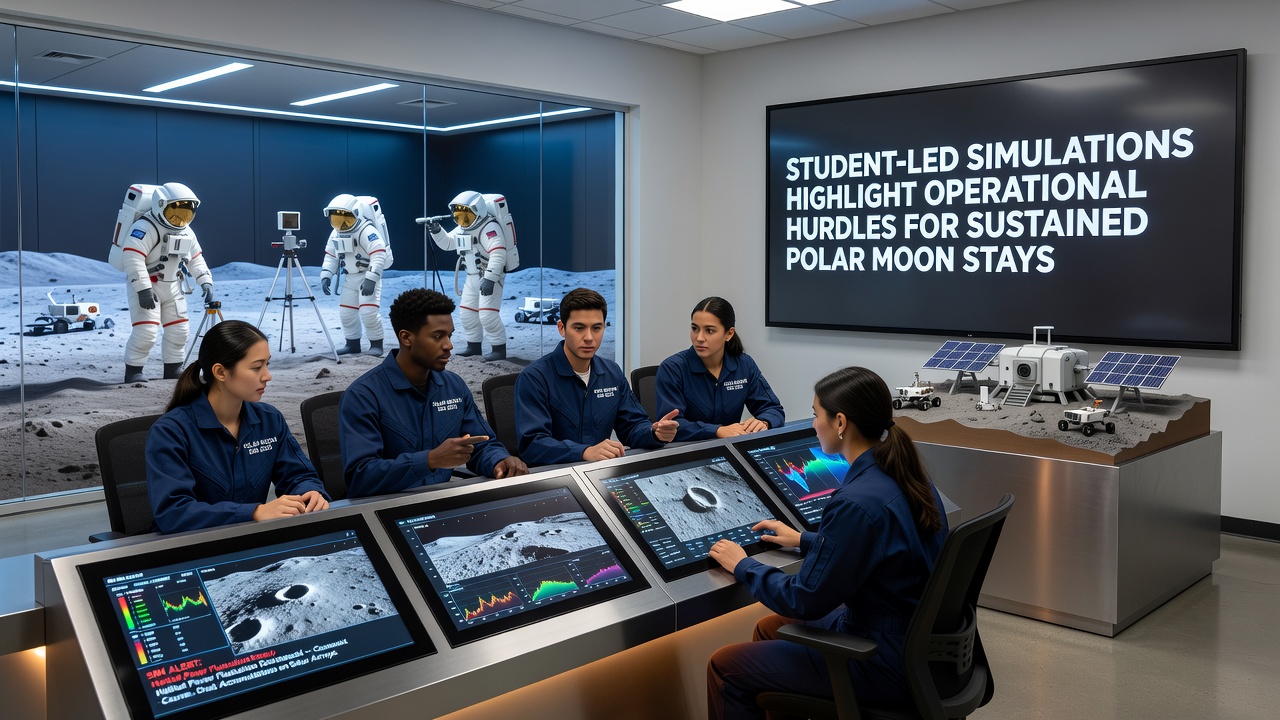
Student teams from multiple universities have completed extended habitat simulations that replicate conditions at the lunar south pole, where continuous sunlight and potential ice deposits create unique operational demands. These exercises, conducted over several months in controlled facilities, exposed specific challenges in power distribution, resource extraction, and crew coordination that would affect any long-duration presence.
Participants operated in pressurized modules with limited external access, managing power cycles tied to the 28-day lunar day while testing extraction techniques for subsurface ice. Data collected during the runs showed that solar array output fluctuated more than expected when dust accumulation combined with low-angle sunlight, forcing teams to reroute energy between life support and science instruments multiple times per cycle.
Key Operational Challenges Identified
Resource management emerged as a central issue because teams had to balance water recovery from icy regolith against the energy cost of heating and processing the material. One group documented that each kilogram of extracted water required nearly three times the anticipated power once thermal losses in the vacuum environment were accounted for, prompting adjustments to daily activity schedules.
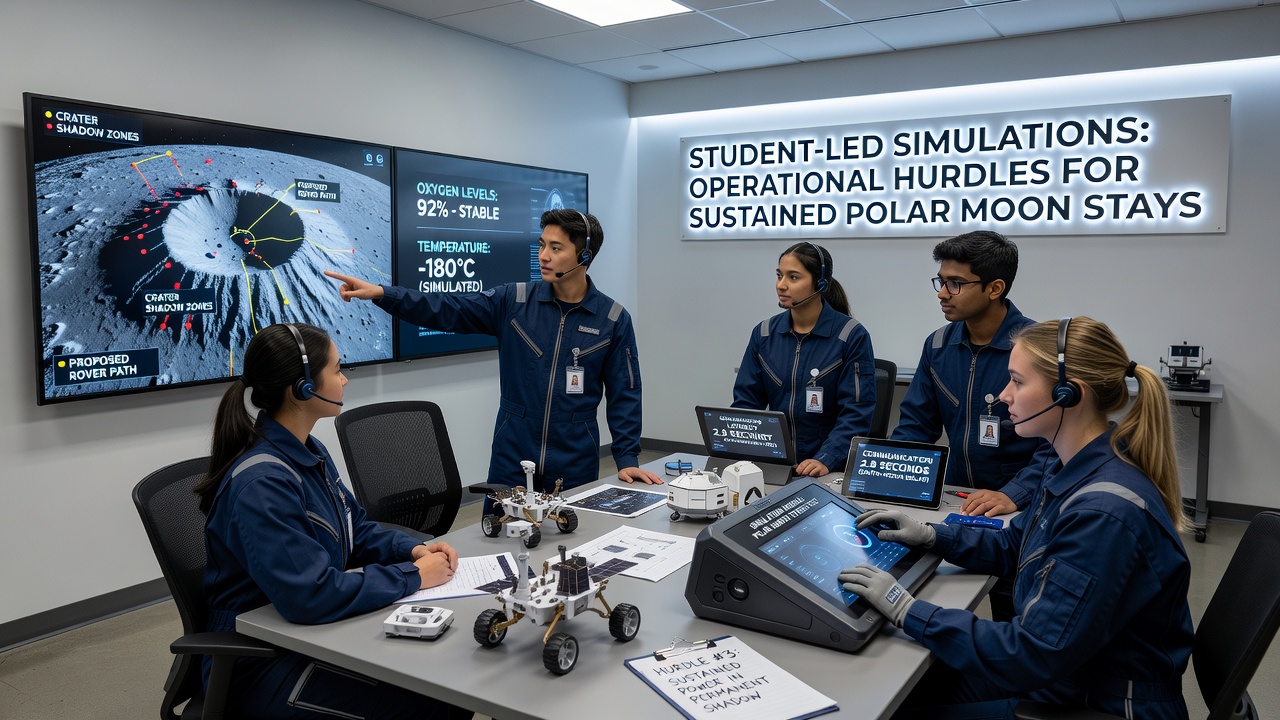
Communication latency between the habitat and Earth-based controllers averaged 1.3 seconds one way, which complicated real-time troubleshooting during equipment malfunctions. Students adapted by developing pre-scripted response protocols, yet several scenarios still required on-site decisions that exceeded the prepared checklists.
Power and Thermal Management
At the south pole, locations near permanently shadowed craters receive near-constant illumination, yet the shallow solar elevation angle reduces panel efficiency. Simulation crews measured a 22 percent drop in expected output after three weeks when fine regolith particles settled on array surfaces, leading them to test robotic brushing systems and alternate panel orientations.
Thermal control systems also faced strain because the simulated habitat alternated between sunlit periods exceeding 120 degrees Celsius and shadow zones dropping below minus 150 degrees Celsius. Crews recorded repeated valve freezes in coolant lines that required manual intervention, highlighting the need for redundant heating elements and improved insulation materials.
September 2026 Simulation Expansion
Plans announced for September 2026 call for a larger-scale exercise that incorporates international partners and extended isolation periods of up to 45 days. Organizers intend to integrate autonomous rovers supplied by the Canadian Space Agency alongside habitat systems developed in Europe, allowing direct comparison of different extraction technologies under identical environmental constraints.
Researchers expect the upcoming runs to generate quantitative benchmarks on crew time allocation, with particular attention to maintenance hours versus scientific productivity. Preliminary models suggest that unscheduled repairs consumed 18 percent of available crew time in the earlier simulations, a figure that could limit mission return if not reduced through better design.
Resource Extraction and Logistics
Teams tested several ice-sampling methods, including auger drills and heated corers, while tracking mass and energy budgets in real time. Results indicated that finer-grained ice mixed with regolith yielded lower water percentages than anticipated, requiring additional processing steps that further taxed power reserves. Observers noted that logistics for storing and transporting the recovered water introduced new bottlenecks when storage tanks reached capacity faster than expected.
Dust mitigation remained a persistent concern because abrasive particles infiltrated seals and bearings despite multiple layers of protection. Maintenance logs from the simulations listed 14 separate instances of equipment fouling that halted operations until crews could perform cleaning procedures in the confined habitat space.
According to NASA mission planning documents, similar dust and thermal issues have been flagged for Artemis surface systems, underscoring the value of the student data sets for refining hardware requirements.
Human Factors and Coordination
Beyond technical systems, the simulations revealed coordination difficulties when multiple student crews rotated through the habitat on staggered schedules. Handover documentation proved insufficient in several cases, resulting in repeated calibration errors on shared instruments. Psychological monitoring showed elevated stress markers during periods of high workload combined with communication blackouts simulated to mimic lunar far-side operations.
Those who reviewed the exercise reports pointed out that small teams adapted faster when given greater autonomy over daily planning, whereas centralized control from outside the habitat increased response times during anomalies.
Conclusion
The student-led simulations have supplied detailed performance data on power cycling, water extraction, and crew procedures that directly inform planning for sustained polar operations. Continued refinement of these exercises through the 2026 expansion will help establish measurable thresholds for system reliability and resource efficiency before hardware is committed to lunar flight.