Hugo Schulz · 23 October 2026
Artemis Lunar Data Sparks International Online Forum Discussions
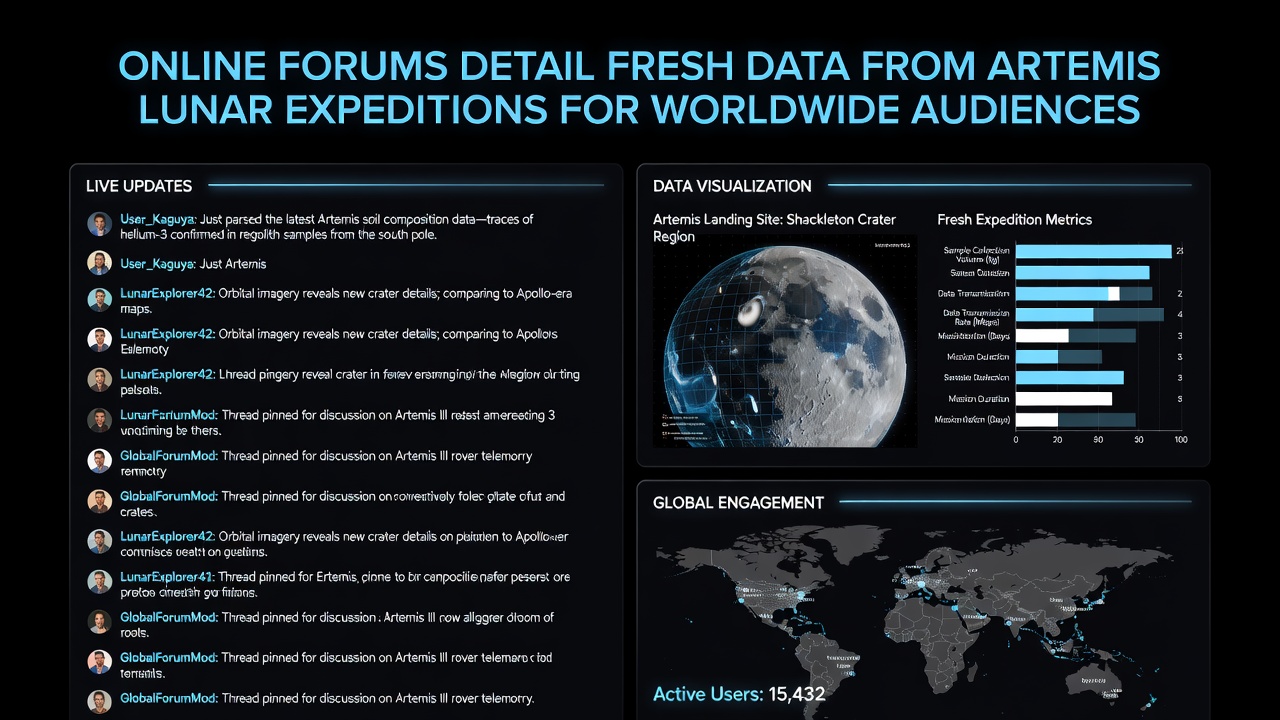
Online forums around the world have become central hubs for sharing and analyzing data from the Artemis lunar expeditions, with researchers and enthusiasts posting detailed breakdowns of orbital imagery, soil composition readings, and radiation measurements collected during recent missions. These platforms allow users to cross-reference information from multiple sources while building collaborative interpretations that reach audiences across continents.
Recent Data Releases and Forum Activity
Artemis program updates in 2025 and into October 2026 continue to generate fresh datasets that forum moderators and contributors upload within hours of official releases, and participants then dissect spectrometer readings along with topographic maps to identify potential resource sites near the lunar south pole. Forums such as those hosted by academic networks and space enthusiast communities feature threaded discussions where users compare Artemis III landing zone scans against earlier survey data, noting variations in hydrogen signatures that suggest water ice deposits at different depths.
One study released through NASA channels in mid-2026 provided high-resolution gravity anomaly maps that forum users quickly integrated into interactive models, and these models helped highlight subsurface structures previously undetected by orbital instruments. Data indicates that such community-driven analysis has accelerated identification of landing sites with lower risk profiles for future crewed operations.
International Participation in Data Exchange
Users from Europe, Asia, and North America contribute translations of technical reports and annotated diagrams, which broadens access for non-English speakers while maintaining scientific accuracy across posts. European Space Agency publications on regolith mechanics appear alongside Canadian Space Agency contributions on thermal mapping, and forum threads connect these findings into unified datasets that researchers reference in follow-up studies.
Forum participants often link to primary sources including the NASA Artemis program archive and reports from the European Space Agency, allowing readers to verify raw telemetry against community interpretations. This practice keeps discussions grounded in verifiable measurements while encouraging broader input from regional observatories in Australia and Japan.
Technical Findings Highlighted in Discussions
Posts detail variations in solar wind interaction with the lunar surface, and contributors overlay Artemis magnetometer readings onto existing models to show how localized magnetic anomalies shield certain craters from charged particles. These observations align with ground-based telescope data collected during the same periods, creating multi-source validation that strengthens the overall dataset.
October 2026 updates included new spectrometer results from polar traverses, and forum users constructed comparative tables showing elemental abundance differences between highland and mare regions. Such tables circulate widely because they support planning for in-situ resource utilization experiments planned for subsequent Artemis flights.
Conclusion
Global online forums continue to serve as accessible channels for distributing Artemis expedition data to worldwide audiences, and the volume of shared files along with analytical tools grows with each mission milestone. Researchers and interested observers access these resources to refine mission parameters while contributing their own cross-checks drawn from independent datasets. The pattern of rapid information exchange established in recent years points toward sustained international collaboration on lunar science topics through these digital platforms.